If you are new to the printing industry, it can get overwhelming, especially if you have no knowledge about the different types of printing services. They have their own advantages and disadvantages. Some of them are better for low volume runs while others might be more suitable for short print runs. It can be hard and confusing to choose the perfect printing service for you so here is a quick guide on the major types of printing services that are open to you.
Here are seven of the most well-known and commonly used types:
Digital Printing
Offset Printing
Flexograph
Large Format
Screen Printing
3D Printing
LED UV
Digital Printing
Often used for:
Business Cards, Brochures, Posters and signage
Labels, newsletters, menus and letters
Digital printing is a modern method that covers a variety of different techniques including inkjet printing and laser. In digital printing, images are sent directly to the printer using digital files such as PDFs. This eliminates the need for a printing plate, which is used in other types of printing such as offset printing, and can save time and money (unless you’re printing in larger numbers).
Digital printing allows for quick turnaround and allows businesses to print on demand. It’s also great for small run jobs – requests can be made for as little as one print. If you choose digital printing for the right job, it can make for a cost-effective method that still produces high quality prints similar to that of the other, bigger-scale options. This printing method is becoming more and more popular because of its high-quality outputs and speedy printing process.
Offset Printing
Often used for:
Bulk Volume Printing
Books, paper, newsletters, leaflets, flyers
Also called as offset lithography printing, this method is a great choice for high volume print runs. Offset printing has the best printing quality among all the printing services. It makes use of plates that are run through water and then ink. What happens is that the ink sticks to the spaces where there are text and images. Water, on the other hand, sticks to the blank spaces or the non-image areas of the plates. One disadvantage is that mistakes can’t easily be changed once the layout has already been placed on the plate.
The two major types of offset presses are sheet-fed and web. The main difference between these two is that in sheet-fed, the paper is already cut prior to printing while in web press, the paper is in a roll first and cut after printing. Offset printing is used on almost any type of printing on paper— brochures, posters, newspapers, magazines, etc.
Flexography
Often used for:
Packaging and labels
Anything with continuous patterns e.g. wallpaper and gift wrap
Have you ever wondered how plastic and grocery bags are labeled? Flexography is the printing service that is responsible for it. Because of its versatility and ability to print on various bases, it is becoming the fastest growing printing processes.
Flexographic printing is the modern version of letterpress printing and is commonly used for printing on uneven surfaces. This style of printing uses quick-drying, semi-liquid inks and can be used for high volume jobs.
Flexible photopolymer printing plates wrapped around rotating cylinders on a web press are used. These inked plates have a slightly raised image of the content on them and are rotated at high speeds to transfer the image onto the print media.
Flexography is a popular choice for its high press speeds, suitability for long runs and ability to print on a huge range of media including plastic, cellophane and metallic film.
Large Format
Often used for:
Large signage e.g. billboards, posters, vinyl banners
Wallpaper and murals
Floor graphics
Laminating
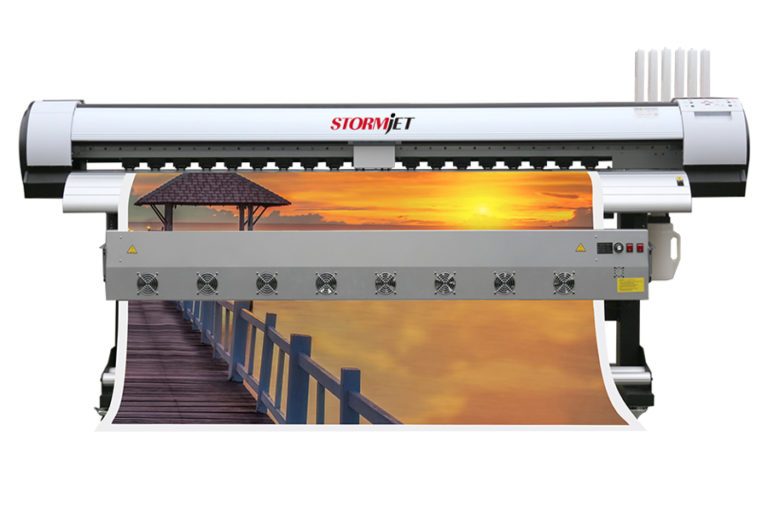
As the name might suggest, large format printing exists to produce maximum print roll width. Perfect for traditional advertising mediums and businesses who are looking to make a huge impact on their customers, this printing method gifts you with a much bigger area to work on, as opposed to the other methods such as digital printing.
Rather than printing onto individual sheets, large format printing uses rolls of prints that are fed incrementally to produce one large sheet.
For large print media such as building wraps, billboards, banners and murals, large format printing is the best option. The other printing methods will not be able to produce as large a material. Most businesses choose large format media to produce flat items which can be hung on a wall, but they can also be folded or made to stand freely.
Screen Printing
Often used for:
Printing logos and graphics onto clothes
Fabric banners, stationery items,metal, fabric
Screen printing is a printing technique where fine material or mesh is used to transfer an image onto another material. The mesh is stretched out so it creates a screen and ink is pressed against it in order to successfully print the image. Popularly used to print graphics onto clothes and other pieces of fabric, screen printing can also be used for paper and metal.
There’s a lot of setting up required with screen printing, so it’s best used for printing repeat items in bulk. It’s not very cost-effective for small number orders. But if you need a lot of the same image, it’s a highly cost-effective method of printing.
3D Printing
Often used for:
Promotion and marketing freebies
Novelty items
Display items, Toy figurines
Since the 1980s, 3D printing has allowed us to print three-dimensional objects, which can be a great way to make an impact on your audience. The desired objects of various shapes and sizes are created using digital model data from 3D models or electronic sources such as an Additive Manufacturing file (AMF). Additive compound mixtures are then fused together to produce this 3D object.
3D printers have continued to get more and more sophisticated. Today, even items with interior moving parts can be printed. After the details have been worked out on a computer programme such as CAD, miniscule layers are printed on top of each other using a special plastic substance.
LED UV Printing
Often used for:
Newsletters, posters and leaflets
Magazines, catalogues, brochures and prospectuses
Stationery
LED UV printing is a method that’s becoming increasingly popular among businesses due to its extremely high quality prints and quick turnaround times.
It’s a form of digital printing that uses UV (ultraviolet) lights to dry the ink as it’s being printed. The drying process, also known as UV curing, is unique and sets it apart from the other printing methods because it’s instantaneous and prevents the ink from sinking into the materials.
The results? You no longer have to wait for the ink to dry, which saves time and the colours come out looking much sharper and clearer.
LED UV is eco-friendly as it uses less power than traditional print machines and unlike many of the other methods, it’s not limited to the type of stock (printing materials) or to certain print jobs.
Its versatility means it’s ideal for a wide range of projects including brochures, catalogues, prospectuses and posters. Because of its ability to instantly dry ink and produce bright, vivid colours, it can turn an ordinary product into a luxury, high quality product that is attention grabbing.